Cyanidin is a natural chemical compound found in plants, fruits, and vegetables. It belongs to the group of anthocyanins, a subclass of flavonoids, which are secondary metabolites in plants that act in the human body by providing beneficial health properties.
Contents
What is cyanidin
It is a natural antioxidant with properties to capture free radicals and block their harmful effects on the body. Cyanidin is a chemical that protects cells from oxidation, also having other properties and benefits such as preventing heart diseases and cellular DNA damage.
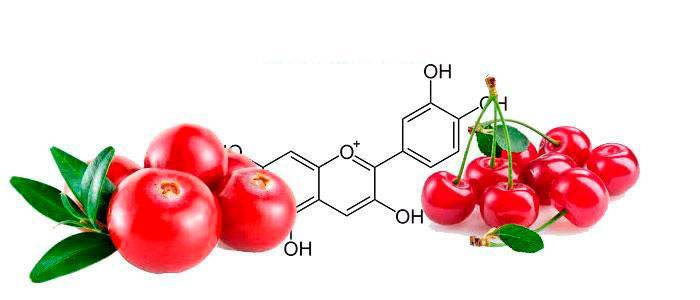
Cyanidin 3 glucoside protects human DNA, preventing abnormal cell growth, which prevents diseases such as cancer.
In plants, it functions as a pigment or dye. It works by staining leaves with color and intensifying the color of the fruits that the vegetables produce.
Cyanidin properties
Various studies have been conducted demonstrating that the administration of cyanidin capsules to controlled patients, as well as the intake of this anthocyanin through food, has anti-inflammatory properties.
There are also data related to the prevention of diabetes since it has an impact on blood glucose levels, also playing an important role in the fight against obesity.
Regarding cancer treatment, although there are currently no drugs made with cyanidin, there is a forecast that it will begin to be studied more deeply to complete research on the benefits for this type of oncological diseases.
Overall, cyanidin is considered one of the most potent antioxidants.
Cyanidin 3 glucoside Antioxidant
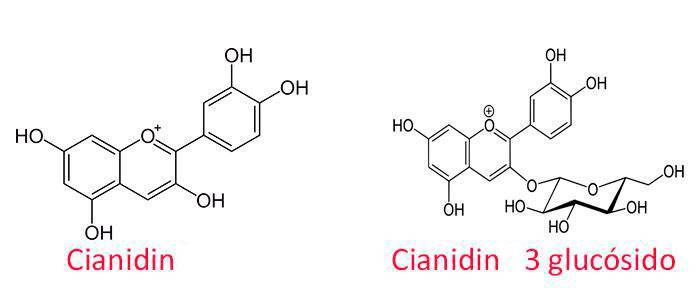
The great advantage of this natural pigment is its power as an antioxidant. Its effects to prevent cellular oxidation are more potent than those of vitamins C and E, making it a fundamental element in preventing premature skin aging, as well as safeguarding against damage from solar radiation.
There are indications that it may also have, in addition to its antioxidant properties, beneficial effects as an antidote. The possibility of including it as a blocker of mycotoxins and toxins that harm humans and are produced by molds such as Fusarium, Aspergillus, and Penicillium is being developed.
Uses as an anti-inflammatory
Although it is not yet being used for this purpose in humans, there are studies where the anti-inflammatory effects of cyanidin relieve pain and produce well-being when there is arthritis.
Cherries, blueberries, and grapes have been used as elements to control the inflammatory response in arthritic animals. However, as we mentioned, this phytochemical still has a long way to go to be used as a treatment for arthritis.
Benefits for diabetes
In another medical field, the study of cyanidin has resulted in a notable reduction in blood glucose levels.
This ability of cyanidin-3-glucoside is a great novelty since it can help control blood sugar spikes and greatly improve the quality of life of diabetic people.
It is thought that in the presence of cyanidin, insulin absorption is much more efficient, causing the body to produce it to a lesser extent.
For obesity
Regarding weight control and the reduction of problems associated with obesity, cyanidin can function as an element to control weight.
In itself, it is not a slimming agent or a fat-burning substance. However, because it has properties to control the level of blood insulin, its presence in the body would facilitate weight regulation.
Uses as E163a dye
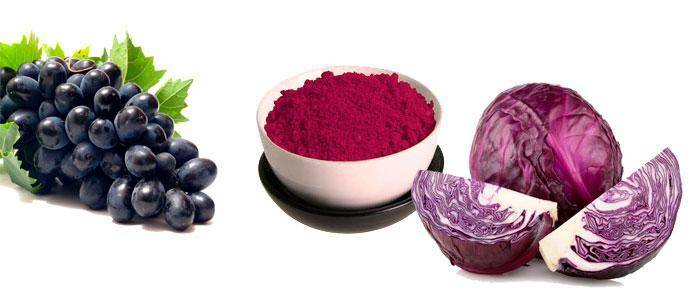
In addition to applications in the pharmaceutical and food industries, cyanidin is sold as E163a, a dye widely used in the textile industry and in food processing.
All anthocyanins are used as dyes or food additives, with the following classification:
- Cyanidin: E163a.
- Delphinidin: E163b.
- Malvidin: E163c.
- Pelargonidin: E163d.
- Peonidin: E163e.
- Petunidin: E163f.
All these natural dyes are used in the manufacturing of beverages and soft drinks, making of gummies and sweet products, as well as in the production of dairy products.
The toxicity level of E163 dyes is low, corresponding to the code SIN163, with its chemical formula being C15H11O6+ (Cyanidol).
Cyanidin as a pH indicator

To obtain it, it is sufficient to heat a portion of purple cabbage (Brassica oleracea) in a pot or saucepan for 5 to 10 minutes. The result is an extraction of cyanidin that serves as a pH and alkalinity indicator.
Cyanidin has the property of changing color when the pH rises or falls, expressing blue and violet shades in neutral mediums (pH of 7).
When the pH is acidic (from 1 to 6), the color of cyanidin shows red shades. If it exceeds average values and the medium becomes alkaline (from 8 to 13), the expressed color will tend towards yellow.
Foods with cyanidin
- Blueberries.
- Red berries.
- Eggplants.
- Red onions.
- Cherries.
- Plums.
- Red cabbage.
- Raspberries.
- Savoy cabbage.
- Apples.
- Purple corn.
- Blackberries.
- Peaches.
- Radishes.
- Grapes.
- Blackberries.
In plants, it functions to provide color since it is used as a plant pigment. The foods with the highest cyanidin content are mostly blackberries, raspberries, grapes, and fruits of red, purple, orange, and blue colors, being very common to find it in the rest of foods with anthocyanins.
In most foods, it can be found naturally and in greater proportion in their skin or peel.
Obtaining
There are different ways, and the most common is through food processing. By extracting the skin of the indicated fruits, it is possible to make different dietary supplements rich in cyanidin.
However, nowadays it is also possible to obtain cyanidin through in vitro cultures of the intestinal bacteria Escherichia coli. This microorganism is capable of producing cyanidin 3-O-glucoside.
It is also possible to obtain cyanidin pigments by boiling red cabbage leaves or vegetables rich in cyanidin glucosides.
More data about cyanidin
- Classified as an anthocyanin, subgroup of flavonoids.
- It is a water-soluble plant compound.
- Acts as a pigment in plants.
- Functions as an antioxidant in the human body.
- It possesses anti-inflammatory properties and has benefits for preventing various types of cancer, diabetes, and arthritis.
- The skin of fruits and vegetables is the richest part in cyanidin.
References
- Metabolic engineering of anthocyanin biosynthesis. [Appl Environ Microbiol. 2005] – PubMed Result.
- https://www.sigmaaldrich.com/catalog/search?term=Cyanidin+3-glucoside&interface=All&N=0&mode=partialmax&lang=es®ion=ES&focus=product.
- https://pubchem.ncbi.nlm.nih.gov/compound/Cyanidin.
- In vitro Antitumor Activity of Cyanidin-3-O-β-Glucopyranoside.


