Malvidin (Mv) is a natural antioxidant compound composed of diglucosides that have protective effects against oxidation in the human body.
In plants, it is naturally present and in humans, it is ingested through food. It can also be used to supplement the dietary intake through a supplement rich in anthocyanin, made from grape skin, or as an anti-aging ingredient part of the composition of wrinkle creams.
Contents
Malvidin
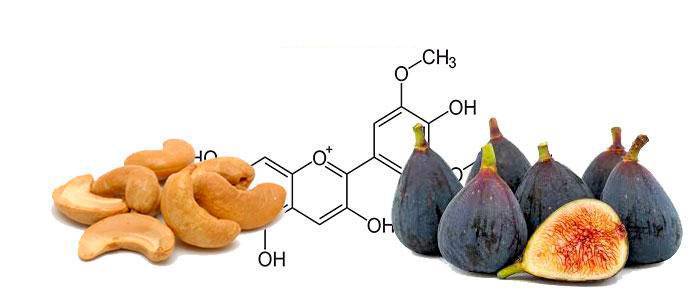
It is a plant chemical compound. Plants naturally produce malvidin and use it as a blue pigment.
Malvidin is an O-methylated anthocyanidin, sharing many of the properties of anthocyanins, as it belongs to the group of natural flavonoids of this class or subgroup.
Glucosides can perform many functions in nature, remaining active or inactive depending on climatic or environmental conditions. In plants, malvin diglucoside gives blue and violet color to flowers, leaves, and aerial parts.
However, when this compound enters the human body, it has different functions, being important in the prevention of some diseases and a great ally in the fight against aging.
Therefore, below are the properties of malvidin.
Properties and Benefits
Despite being the main pigment in plants, studies in humans are scarce.
While the effects of some anthocyanidins such as cyanidin, peonidin, and the bioactive delphinidins are known, with malvidin, another anthocyanin from the same group, there is less data on health benefits.
Data indicate that it has anticancer effects. It has potent antioxidant effects that protect against damage from solar radiation (UVA and UVB). It protects against skin aging and prevents the formation of some types of cancers such as pancreatic, colon, and breast cancer.
There is an in vitro study that shows malvidin is cytotoxic to leukemia cells, causing their death when continuous doses of malvidins or malvin 3-5 diglucosides are administered.
This study indicated that the cellular apoptosis of cells in the G(2)/M phase increased when solutions of malvidin with 40 ppm were added. The result was a much lower leukemia cell growth, approximately 50% of the usual and expected. Malvidin from black rice was used for the tests.
Foods

- Blueberries.
- Green and black olives.
- Cashews (Anacardium occidentale).
- Black rice.
- Aronia berries (Aronia sp.).
- Serviceberries (Amelanchier alnifolia).
- Cherries.
- Plums.
- Raspberries.
- Red fruits.
- Black peas.
- Figs.
- Red cabbage.
- Mallow (Malva sylvestris).
- Turnips.
- Peppers.
- Primrose (Primula plant).
- Primula (Primula spp).
- Blue pimpernel (Anagallis monelli).
- Rhododendron (Rhododendron).
- Purple corn.
- Radishes.
- Beets.
- Rhubarb.
- Tomatoes.
- Red wine (from vitis vinifera).
- Carrots.
Fruits and berries of violet, black, and intense red colors are the foods with the most malvidin.
Black rice has been used as a primary source to obtain malvidin and its glucosides in laboratory experiments, also found in large quantities in other foods such as grapes, blackberries, berries, and purple corn.
Colorant E163c
Once malvidin pigments are obtained, they can be used as a natural colorant E163c.
Its color is purple, often extracted from the skin of black grapes. This fruit is widely used to obtain various colorants classified as E163, many of which belong to anthocyanins.
In its form as colorant E163-C, it can be used in foods as it is non-toxic and free from side effects except for some exceptions where hypersensitivity to one of its components occurs. Generally, malvidin as a colorant is used to make dairy products, yogurts, soft drinks, and candies.
Trade Names
- Maldinas.
- Malvidinina.
- Malvidin.
- Malvidin 3-5 diglucoside.
- SIN163c.
- Malvidininas.
- Malvinas.
Malvidin Glucosides

- Malvin.
- Malvidin 3-rutinoside.
- Malvidin-3-O-glucoside-5-O-(6-acetylglucoside).
- Oenin.
- Primulin or Primulin (malvidin 3-O-galactoside).
Malvin is a malvidin glucoside (malvidin diglucoside). It belongs to the anthocyanin family. It can be obtained from plants such as Mallow and Rhododendron.
Malvidin 3-rutinoside is the pigment that colors aerial parts of plants such as violets, Siam tulip (Curcuma alismatifolia), and acylated malvidin 3-rutinoside is responsible for the violet coloration of Petunia flowers (Petunia integrifolia subsp. Inflata).
Malvidin-3-O-glucoside-5-O-(6-acetylglucoside) is a pigment that provides blue tones to geranium flowers. Its color is classified as «Blue Johnson«.
Oenin is a pigment that acts as a dye in vegetables, often referred to as Oenin -3- O-. It imparts red color in red wine and grapes.
Primulin is malvidin 3-O-galactoside, with estrogenic effects. Included in supplements and nutraceutical products to treat menopausal symptoms.
References
- MSDS from CarlRoth.
- A. Joule, K. Mills: Heterocyclic Chemistry., p. 173, Blackwell Publishing, 2000, ISBN 978-0-632-05453-4.
- Chang, S; Tan, C; Frankel, EN; Barrett, DM (2000). «Low-density lipoprotein antioxidant activity of phenolic compounds and polyphenol oxidase activity in selected clingstone peach cultivars». Journal of agricultural and food chemistry 48 (2): 147-51.
- Food allergies, allergy of Malvin symptoms.
- Phytochemicals, Malvidin. Top Cultures. Accessed May 20, 2009.
- Mazza, G (2005). «Compositional and functional properties of saskatoon berry and blueberry». J. Fruit Sci. 5 (3): 99-118.
- Bakowska-barczak (2007). «Survey of bioactive components in Western Canadian berries». Canadian Journal of Physiology and Pharmacology 85 (11): 1139-52.
- Nakayama M, Roh MS, Uchida K, Yamaguchi Y, Takano K and Koshioka M, Biosci Biotechnol Biochem.
- Malvidin 3-rutinoside as the pigment responsible for bract color in Curcuma alismatifolia, 64(5), pages 1093-1095.
- Acylated malvidin 3-rutinosides in dusky violet flowers of Petunia integrifolia subsp. inflata. 1999, 52, pages 351-355.
- Malvidin-3-O-glucoside-5-O-(6-acetylglucoside) and its colour manifestation in ‘Johnson’s Blue’ and other ‘blue’ geraniums. Markham K.R., Mitchell K.A. and Boase M.R., Phytochemistry, 1997, Volume 45, pages 417-423.


